

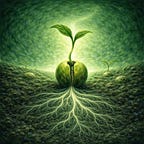

This poem is a poetic and political manifesto at the same time, proposing a radically new way of understanding community, power, and identity in the digital, post-national era.
The text opens by rejecting the classical model of the State: “A Nation Without Walls, A DAO With a Soul.” It is not about creating a country with borders, an army, or territory, but an ethical and symbolic nation, a community that exists through shared will. The reference to a DAO (Decentralized Autonomous Organization) signals the presence of technology, but always subordinated to something deeper: soul, memory, and human responsibility.
When it states “We are not a people seeking a State,” the poem refuses the logic of conquest and external validation. This community does not seek power over others, but inner coherence. It is “a voice that remembers” what the world has forgotten: the ability to govern ourselves through respect, care, and dialogue.
One of the central ideas is fractality: every person is a node, and every node contains the whole. This means the community is not hierarchical, but horizontal and interconnected. There is no imposed bloodline, origin, or identity, only shared intention. Belonging is not inherited; it is felt.
The poem redefines classical concepts of power:
justice does not punish; it restores
transparency does not expose; it illuminates
reputation grows from loving action, not ambition
words do not divide; they care
Laws are no longer stone, but water: flexible, revisable, alive. This implies an ethics of process, error is not failure, but learning material; disagreement is not a threat, but an opportunity for growth.
The organization through subDAOs (health, culture, justice, memory, exchange…) presents the community as a garden: it is cultivated, not imposed. Participation is not an obligation, but a heartbeat; voting is not a weapon, but a breath. Leadership is rotating and humble, and even fatigue is acknowledged as legitimate. There is space to rest, to dissent, and to open new paths.
Spiritually, the poem is inclusive without being dogmatic: it denies no spirituality, but imposes no god. The sacred is not doctrine, but the dignity of life and the beauty of deciding together.
The closing lines are especially powerful and poetic:
“We have no army. We have poems.
We have no borders. We have bridges.”
They encapsulate the entire proposal: power is not force, but shared meaning; identity is not exclusion, but relationship.
Finally, the poem directly addresses the reader. It does not say “join us,” but something more subtle: if these words resonate with you, perhaps you already belong. This nation is not founded with a flag, but with inner recognition.
At its core, the poem imagines a new possible civilization: small, luminous, without walls or conquest, grounded in the sacred fractality of people who choose, together, to remember another way of living.
A Nation Without Walls,
A DAO With a Soul.

We are not a people seeking a State.
We are a voice that remembers what the world has forgotten.
We are the pact between silence and speech,
between ancestral memory and transparent code.

We rise, sovereign nodes of a map without coordinates,
to found an experimental nation, a living fractality,
a space without walls where governance springs from ethics
and the future is co-created from the root.

We do not claim land, nor slices of sky,
but the right to a community founded not in blood,
but in shared will.

Here, every soul is a node.
Every node, a voice.
Every voice, a promise.

We accept that no true power arises
except from respect, dialogue,
and the ability to recognize the other as a mirror.

We believe in justice that restores, not punishes,
in transparency that enlightens, not exposes,
in reputation that grows from loving action, not ambition,
in words that care, not divide.

Our laws are not stone,
they are water: flexible, revisable, alive.
Every norm can be refounded, every error understood,
every disagreement embraced.

We organize our life as one who tends a garden:
with subDAOs that nurture health, culture, knowledge,
justice, exchange, memory.
Everything is built as a network,
everything is a fractal of a shared heart.

Participation is not an obligation, but a heartbeat.
The vote is not a weapon, but a breath.
Leadership is rotating, symbolic, humble.

Those who tire, may rest.
Those who dissent, may forge a new path.

This space denies no spirituality,
but imposes no god.
We believe in the sacredness of life,
in the mysterious dignity of existence,
and in the beauty of deciding together.

We have no army. We have poems.
We have no borders. We have bridges.
We have no king. We have consensus.

This is how we are born.
Not with conquest, but with a murmur.
Not with a flag, but with a candle.

We are the Sacred Fractality,
the branch growing toward a new civilization.
We may not be many, but we will be light.

And you, who are reading, may not yet be among us…
but if you feel that these words speak to you,
perhaps it is because you already are one of us.


