


This micro-essay is a poetic and visionary reading of Nikola Tesla’s thought, but it goes far beyond biography or science. Tesla is used as a symbol of the threshold between technology, consciousness, and mystery.
The text opens with Tesla’s coil as a gateway to wonder. It is not merely a technical device, but a liminal space. The sparks that leap “like celestial whispers” transform electricity into language, into music. Science here is not cold; it is song, vibration charged with infinite potential. Tesla is not imagining isolated machines, but a dance of energy uniting heaven and earth, matter and the unseen.
When the world becomes a “living circuit,” the text introduces a radical idea: Earth not as a resource, but as a resonant organism. Wireless energy is not only a practical solution, but a metaphor for an interconnected reality where separation is an illusion. The towers that “sing to the stars” evoke ancient temples and spiritual beacons, technology and the sacred merge.
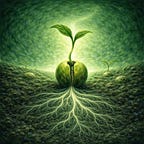
Tesla’s dream is described as too vast for its time. Here lies a key insight: humanity often receives visions before it is mature enough to sustain them. The dream is not a failure; it is suspended, waiting for a future capable of welcoming it. Tesla is not a historical mistake, but an early seed.
The turning point comes when energy ceases to be mere electricity and becomes an invocation of the unseen. Electromagnetic fields are “invisible hands” igniting distant lights, but also memories and forgotten truths. Science touches metaphysics here: fields do not only transmit power, they transmit connection.
The central question is almost mystical: what if frequencies could transmit thoughts, emotions, entire worlds? The text suggests portals where space and time dissolve, not as simplistic science fiction, but as a natural extension of a vibrational reality. Travel would no longer be movement through space, but attunement.
The idea that “vibration is the key” gathers the whole vision. Tesla is portrayed as sensing a cosmic harmony, a resonance shared by neurons and stars alike. This aligns him with ancient wisdoms, akashic fields, where knowledge does not reside in storage, but rests in the fabric of existence.
The ending opens time itself. The dream has not died; it has simply not yet blossomed. The text trusts that one day humanity will learn to play these symphonies of energy without destroying them. The “bridges of light and thought” are not only infrastructures, but new states of consciousness.
The final affirmation is essential: energy is eternal, and through it we may transcend, not by escaping the world, but by inhabiting it at a deeper level, where science, spirit, and imagination are no longer separate.
At its core, the micro-essay says that:
Tesla embodies a future intuited too early,
the universe is vibration and relationship, not isolated objects,
and the true technology of the future will be the one that unites energy and consciousness.
It is a text about the nostalgia of the future: something that does not yet exist, but is already calling us.


